NEWS                                          ARCHIVE     2008     2007     2006     2005


21 - 23 October 2010
space RE:solutions Vienna


space RE:solutions
Intervention and Research in Visual Culture

International conference hosted by the Visual Culture programme
Vienna University of Technology

21 - 23 October 2010

The conference aims to generate a discursive platform for both theoretical and practical approaches of engagement in spatial processes. Focal point is the dynamics of critical and creative work in the field of visual culture. Exploring the blurring boundaries of intervention and research, the conference will embrace the unpredictable movements and ambivalences of individual and collective, real and virtual, centre and periphery, activism and academy.


16 - 18 September 2010
University of Cork


Ordnance: War, Architecture & Space
An interdisciplinary conference organized by the Cork Centre for Architectural Education (CCAE) and School of the Human Environment (University College Cork)

This international interdisciplinary conference seeks to explore the often hidden relationship between militarism and the design and construction of architecture and space in the modern period. Historically, military imperatives have been embedded in the way society is organized and, from the Renaissance onwards, the needs of offence and defense played an increasingly influential role not only in the physical shaping of the city and landscape, but also on the means by which they were represented. Recent events, notably the ‘War on Terror’ have reinforced these impulses within the city, extending and deepening systems and architectures of surveillance.

16th to 18th September 2010

excerpt from conference programme:

Friday 17 September 2010
9.30-11 am PARALLEL SESSIONS

9 THREAT

Security Assemblages and Spaces of Exception: The Production of (Para-) Militarized Spaces in the ʻWar on Drugsʼ
Markus Kienscherf, Department of Sociology, Graduate School of North American Studies, Free University Berlin

The Political Aesthetics of Counter-Terrorism Design
Peter Mörtenböck & Helge Mooshammer, Vienna University of Technology and Goldsmiths, University of London

Making Way for the War on Terror in a Canadian Suburb
Joy Parr, Geography, University of Western Ontario.


28 - 30 June 2010
Metropolis Laboratory Copenhagen


METROPOLIS LABORATORY 2010
28-30 JUNE 2010

DANSEhallerne, Carlsberg
Pasteursvej 20, COPENHAGEN 

29 June 2010, 3.00-4.30pm

Networked Cultures presented by project director Peter Mörtenböck (AT/UK) and co-director Helge Mooshammer (AT/UK)
The presentation will include an interaction with off-site contributors to the Networked Cultures project through excerpts from the Networked Cultures documentary.

Programme 28-30 June 2010


Initiated in 2007, the Metropolis Laboratory and Metropolis Biennale in Copenhagen is already established as a focal point for a generation of international artists, researchers and practitioners involved with urbanism.

Part think tank, part network and part project base, Metropolis Laboratory 2010 will be held at the former Carlsberg Breweries in the heart of Copenhagen. Itself a historic environment, the area is gradually being transformed by arts and cultural institutions – among others DANSEhallerne.

Metropolis was initiated by Copenhagen International Theatre as the frame for a 10 year programme (2007-2017). The main theme of Metropolis is the urban condition as perceived, commentated, contested and developed in the realm of the arts.

Metropolis is in particular looking at interdisciplinary initiatives which reflect an increasing engagement and relevance of the arts in the public realm – from community theatre, site specific work, arts, architectural collaborations and new media. Working in the arts in this complex and often turbulent environment, not only aesthetic but also urban, social and political issues are not only relevant but often agenda setting.
New technologies change the nature of the understanding of the public realm and concepts of community. Urban planning and market mechanisms often collide with the notions of naturally evolving and diverse but balanced and vibrating urban environments.

The acclaimed loss of “cityness” and of interaction and engagement with the city together with the threatening stereotypes of urban expansion of the past generations has created a vital forum where the future of the city must be rethought and retested.

In this context the role of Metropolis is to replace “artworks” by “art that works”. Not becoming less “art” but becoming more relevant and putting the artist at the core of this change of practice which we see in many cities, where a more organic, complex, artistic and culturally based philosophy of urban change is being seen as a guiding principle.

Metropolis Laboratory is organised as a professional forum with invited researchers and practitioners from the social sciences, the arts and architecture, alongside with producers, curators, community representatives, developers and local authorities. 


February 2010
[transcript] Verlag

Peter Mörtenböck, Helge Mooshammer

Netzwerk Kultur

Die Kunst der Verbindung
in einer globalisierten Welt


Erscheint April 2010

Bielefeld, [transcript] Verlag
für Kommunikation, Kultur und soziale Praxis
Reihe Kultur- und Medientheorie

ISBN 978-3-8376-1356-8


Netzwerke sind zur Leitfigur des Zusammenlebens im 21. Jahrhundert geworden. In Gestalt von transnationaler Politik, globaler Ökonomie, neuen Medien und sozialen Bewegungen verkünden sie Hoffnung und Bedrohung zugleich. Dass Netzwerke und vernetzte Kulturen vor allem auch Kreativität hervorbringen können, zeigt dieser Band: Er liefert eine faktenreiche und vielschichtige Analyse der Schauplätze der geokulturellen Neuordnung und demonstriert anhand von zahlreichen Allianzen in Kunst, Architektur und Aktivismus, wie durch kollektive Kreativität neue Strukturen politischer und sozialer Teilnahme entstehen.


11 March - 11 April 2010
Mestna Galerija Ljubljana


Installation of Networked Cultures documentary at

COMMUNICATION NETWORKS - Art Institutions and New Publics

Mestna Galerija, Ljubljana

11 March - 11 April 2010


28 November 2009
Psychoanalytisches Seminar Zürich


Transparenz und Intimität
Symposium

Samstag, 28. November 2009, 12.00 – 17.00 Uhr
Kunstraum Walcheturm
Kanonengasse 20
8004 Zürich


Anlässlich der diesjährigen Verleihung von ‚The Missing Link – Der Preis für Psychoanalyse und’ veranstaltet das Psychoanalytische Seminar Zürich zusammen mit der Zeitschrift Hochparterre ein interdisziplinäres Symposium zu Architektur und Psychoanalyse: Transparenz und Intimität.

Mit:
Stanislaus von Moos, Zürich
Christian Kerez, Zürich
Eva Laquièze-Waniek, Wien
Helge Mooshammer, Wien

Psychoanalytisches Seminar Zürich: Symposiumstext

Hochparterre Schweiz: Architektur und Psychoanalyse: Transparenz und Intimität


23 November 2009
Universität Karlsruhe


brandingKonsumbranding - über den wa(h)ren Wert von Architektur
Montagsreihe

Montag, 23. November 2009, 18.00 Uhr
Universität Karlsruhe
Fakultät Architektur
HS Egon Eiermann


malls&more

mit:
Peter Mörtenböck, thinkarchitecture, Wien / A
Wolfgang Pöschl, tatanka ideenvetriebs GmbH, Mils / A
Holger Pump-Uhlmann, TU Delft / NL
Alex Wall, KIT Karlsruher Institut für Technologie

"[...] Architektur wird dabei immer mehr zum zentralen urbanen Medium der Inszenierung. Vom Branding der Locations bis zur langen Nacht der Museen: der gesteigerte Stadtkonsum braucht die Architektur als Bühne. Architektur bedient den Lifestyle der "Urbaniten" ebenso wie die Inszeniierungskultur von Museen und Festivals. In Film und Presse gerät Architektur in ein anderes Medium, sie wird selbst konsumiert. Als Konsumgut bedarf die Architektur eigener Auftritte, Marketing und Medialisierung sind zwei Seiten einer Medaille. Die Markenkultur braucht ihre Ikonen, die "Ökonomie der Aufmerksamkeit" findet ihre Eventarchitektur. [...]“

weitere Termine


21 November 2009
General Public Berlin

STRUCTURES NODE 3: In Between Categories

Friday, 20 November – Sunday, 22 November 2009
General Public
Schönhauser Allee 167c
10435 Berlin


Day 2 - 21. November 2009
Conference

DISPLAYS FOR BECOMING PRESENT / EXHIBITING NETWORKING

This conference will consist of public brainstorming about spatial conceptualizations of artistic projects of a translocal and transdisciplinary nature. We aim to articulate possibilities on how we can develop and realize present places of production and how we can present these projects. Architects, curators, artists, researchers, and theoreticians will introduce their projects in the form of statements. Respondents will counter their short contributions. Thematically, the conference takes off from two threads: space and network.

The aim of the conference is to conduct a debate about the conditions of production as well as to present forms of practice that involve contemporary technologies, everyday media, audio culture, and participatory models. Following the approach of Networked Cultures, these projects will not be considered in the light of the promise of mechanistic innovations in the technology of digital culture. Rather the aim is to investigate the extent to which technologies influence social practices, information exchange, and political activism under everyday conditions and at locations of cultural transformation.

In particular, digital technologies change our understanding of proximity and distance, and also the ways in which we work together. Ad-hoc communication takes place over thousands of kilometres. The construction of identity is permanently in progress and generates multiple relations. Distances become calculable numbers that shed light on the acceleration of connections and of global partnerships. National, social and cultural concepts resist hegemonical lines of demarcation. – Networked Cultures takes off from a heterogeneous present state of society under post-colonial conditions. It is impossible to hark back to older forms of production and presentation. Networks act through permanent shifting. Needs, fears, and desires at present lead networks towards modes of dispersion.

It seems that Networked Cultures are our avant-garde. Nevertheless, they can hardly assert an autonomous status. Networking practices activate temporary environments and agonistic publics, which operate within various politics of mobility and through different organizational and political structures. For example, research by Peter Mörtenböck and Helge Mooshammer suggests that Networked Cultures are an approach that “replaces the most powerful figure of modernity: the threatening figure of the masses in the nineteenth and twentieth centuries”.

What are the dispositifs and spatial models that display the politics of networking? Which specific spatial formats make current projects manifest? How could institutional concepts, e.g. for Media Labs, be re-thought and developed today?

The conference is the first of a series of events to be held with international partners. The programme has been set up by Doreen Mende as part of the curatorial grant 2009 of Labor für Kunst und Medien Berlin. The contributions and discussion will be mainly in English.

14:30  Part 1
Beryl Graham (curator Sunderland University, crumbweb.org)
Agnes Meyer Brandis (artist)
Herwig Weiser (artists)
Respondent: Alexander Klose (author & researcher)

16:00 Part 2
Peter Mörtenböck (architect, networkedcultures.org)
Peter Hanappe (Sony Computer Science Laboratory, Paris)
Respondent: Sabeth Buchmann (professor for art and theory, Vienna)

16:30 Part 3
Nikolaus Hirsch (architect, culturalspaces.in)
Trebor Scholz (New School in New York, digitallabor.org)
Respondent: Stefan Römer (professor for media theory and conceptual artist)

20:00 Final Discussion: With all participants.

22:00 Performance: "Open Core" by Julien Maire (FR)


19-22 November 2009
AHRA Conference 2009

Field/work
6th annual Architectural Humanities Research Association international conference

19-22 November 2009
University of Edinburgh
Edinburgh College of Art


Fieldwork has always been integral to the work of architects and landscape architects and the many forms of associated scholarship, from the site visit to the grand tour to the social survey. We visit sites - real and imagined - to collect, order, and interpret data, to establish parameters, frameworks, contexts and outlines for design work. As the sites of design work and scholarship have become increasingly complex and mediated, the questions as to what and where the field is, how we collect data, how we ensure its reliability, and how it informs design work have renewed theoretical and practical significance.

Design based disciplines share a wider heritage with empirically-oriented disciplines such as anthropology, ethnography, archaeology, material culture and georgaphy. This conference seeks to examine the question of field/work in its historical, contemporary, disciplinary and inter-disciplinary terms. What is it to work in the field, to travel to the field, make transmissions from the field, to translate between field and studio, and to process data after the field?

The conference aims to address conventions of praxis/action and field/work across media, scales, cultures; to articulate current discourses on the topic, and to identify critical dilemmas and opportunities for future practices of design and research.


Excerpt from programme:
Friday, 20 November 2009, 3.15-4.30 pm, Geddes Room

Spatial field practices + strategies

Chair: Dagmar Weston
Tatjana Schneider
(University of Sheffield), Jeremy Till (University of Westminster): The sites of Spatial Agency
Peter Mortenbock (Goldsmiths College, University of London), Helge Mooshammer (Goldsmiths College, University of London): Re(in)stating the field - Networked Cultures Dialogues
Paul Jenkins (ESALA, Edinburgh College of Art): Working across fields of architectural knowledge

detailed programme (pdf)

conference blog


14 November 2009
AIT-ArchitekturSalon Hamburg


Queer Spaces – Definitionen eines verdrängten Raumes
Symposium

Samstag, 14. November 2009, 13.30 – 19.30
AIT-ArchitekturSalon
Bei den Mühren 70
20457 Hamburg


mit:
Wolfgang Voigt, Frankfurt: Über die verschwiegenen Biographien homosexueller Architekten
Mary Pepchinski, Berlin/Dresden: Zelebriert, Verdrängt: Moderne Wohnarchitektur für Lesben, 1870-1950
Jan C. Kapsenberg, Amsterdam: Erotic Manoeuvres: Territories of Desire – Ein Toolkit zu Begegnungsbereichen
Helge Mooshammer, London/Wien: Cruising – Anstöße in der Architektur
Uwe Bresan, Stuttgart & Christian Bomm, Weimar: Leben im Camp – Schwule Wohnkultur zwischen Klischee und Wirklichkeit

Abschlussdiskussion mit Dionys Ottl, München: Der Blick des schwulen Architekten

Programm Symposium (pdf)

Sonntag, 15. November 2009

10.00 – 11.00: Brunch im AIT-ArchitekturSalon
11.00 – 13.00: Themenspezifische Stadt- und Architekturführung, Treffpunkt AIT-ArchitekturSalon

taz.de: Cruising als Architekturmodell, Michael Kasiske
Bauwelt 47/2009: Learning from Queer Spaces, Jan Friedrich


31 October 2009
Architekturzentrum Wien


Other Markets
Symposium

Saturday, 31 October 2009, 2 - 8 pm
Architekturzentrum Wien
Museumsplatz 1
A-1010 Vienna


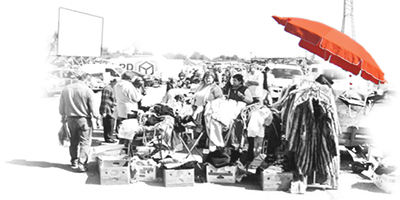
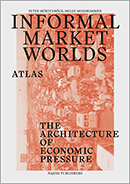
Spurred by economic deregulations and the intertwined mobilisation of people and goods, informal systems have taken on a global dimension in structuring how we connect to each other, how we inhabit our environments, and how we engage in political and social operations. Rampant informal markets along the European peripheries, for instance, have mushroomed into novel and extreme material configurations. Are these architectures of informal exchange the low-cost equivalent of the success of the global capital market or does their creativity point towards more sustainable ecologies?

The symposium, initiated by the FWF (Austrian Science Fund) research project ‘Relational Architecture’, aims to critically examine the role of architecture in this transformation of our political and economic environment, ranging from the local sphere of neighbourhoods to the civic potential of transnational regions.

with
Peter Mörtenböck, TU Vienna
Helge Mooshammer, FWF-research project 'Relational Architecture'
Marjetica Potrč, Ljubljana
Teddy Cruz, UC San Diego
Irit Rogoff, Goldsmiths, London

detailed programme (pdf)


Programm Symposium (pdf)
University of Edinburgh
Edinburgh College of Art


21 October 2009
Kunstuniversität Linz


SUPERSTADT!
Ein Symposium zur sozialen Utopie der Stadt

Mi, 21. Oktober 2009, 10.00-20.00 Uhr
Kunstuniversität Linz
Audimax
Kollegiumgasse 2, 1. Stock
4010 Linz

Fünfzig Jahre nach den letzten großen Stadt- und Gesellschaftsutopien wie Constants New Babylon, Yona Friedmans Ville Spatiale und Superstudios Megastruktur sind radikale Gegenmodelle zu bestehenden Städten rar geworden. Dennoch erleben Idealstädte eine neue Renaissance. Nach Vorbild klassischer Utopien entstehen sie auf künstlichen Inseln oder mitten in Wüsten, im Unterschied zu Utopia sind sie jedoch nicht gesellschaftlich, sondern rein ökonomisch motiviert und vermitteln anstelle einer sozialen Utopie das homogene Bild globaler Indifferenz.

Der Anspruch moderner Architektur, neue Städte für neue Menschen zu designen mag gescheitert sein, die gesellschaftspolitische Rolle der Stadt ist angesichts von Krisen aktueller als je zuvor.  SUPERSTADT! greift die Idee einer sozialen Utopie der Stadt wieder auf, begibt sich auf die Suche nach ungewohnten bis unerhörten Stadtmodellen und changiert zwischen urbaner Phantasie und Strategie, zwischen Idealstadt und spontanem Eingreifen, zwischen Superstruktur und Experiment. ArchitektInnen zeigen provokante Stadtentwürfe, PhilosophInnen streiten mit SoziologInnen über die Zukunft der Stadt, KuratorInnen und KünstlerInnen vermitteln zwischen Stadtraum und Stadtbenutzenden und Djanes organisieren ein Superfest.

Kuratiert von Sabine Pollak, Architektur | Urbanistik, Kunstuniversität Linz

Moderation: Ute Woltron, Architekturjournalistin

mit
Anette Baldauf, Soziologin, A
Thomas Macho, Kulturwissenschaftler und Philosoph, A/D
Jörg Lukas Matthaei, Regisseur, D
Andreas Klok Pedersen, Associate Partner BIG Bjarke IngelsGroup, DK
Peter Mörtenböck & Helge Mooshammer,ThinkArchitecture A/UK
Sabine Pollak, Architektin und Architekturtheoretikerin, A
Susanne Rogenhofer aka Sweet Susie, DJane and Musikerin, A
Wolfgang Schlag, Hörfunkjournalist und Kurator, A/NL
SPLITTERWERK, Label für Bildende Kunst
Milica Topalovic, Architektin, SRB/CH

Flyer (pdf)


29 September 2009
Academy of Fine Arts, Vienna

Open Space

book launch of
Open Space - Mapping contemporary creative practice / Open Space - Schnittpunkte Aktueller Kunstpraxis
Edited by Gülsen Bal

29 September 2009, 7 - 9 pm
Akademie der bildenden Künste Wien
Aula
Schillerplatz 3
A-1010 Vienna

with
Gülsen Bal
Marina Gržinić
Peter Mörtenböck and Helge Mooshammer
Walter Seidl
Andreas Spiegl


The book is a reader on the program of 2008 taking place at Open Space. It aims to put across different creative production in each individual project which is engaged with a continual research on contemporary art looking for new outlines of the possible practices where each project remains as accountable for a new discourse to be discussed. Open Space offers a place for exploration of space of current relations that shape project-specificity within multi-directional models.

Publisher: Divus
http://www.divus.cz

For further info please contact: office@openspace-zkp.org
This event kindly supported by ]a[ akademie der bildenden künste wien


26 September 2009
Austrian Cultural Forum, London

MAKING A LIVING: Artistic Survival in 2009

Saturday, 26 September 2009, 2 - 5 pm
Austrian Cultural Forum, 28 Rutland Gate, London SW7 1PQ

Turn up and pitch in! A chance to share different approaches and ideas to sustain critical art practices before, during and after the recession.

MAKING A LIVING aims to highlight and discuss diverse ideologies underlying how we support and sustain 'critical art practices'. How do our conceptual and pragmatic assertions impact on the way we choose to make a living and vice versa? We will investigate and invent a range of economic and conceptual models of artistic survival that move beyond the knee-jerk reaction to become 'culturpreneurs' in the creative industries.

As well as the issue of aiming to make a living through art we will ask ourselves what are the side-effects of such a career path, what are the alternatives and how do we negotiate the cultural production line we are inevitably a part of?

As a playful exercise in opening up the debate around these issues, attendees will be asked to decide how to spend the funding we received for this event - £500 from the Austrian Cultural Forum. There will also be an opportunity on the day for anyone present to tell us their ideas, experiences, ruminations, convictions and strategies of sustaining a critical art practice during five minute soapbox sessions followed by discussion on these proposals.

MAKING A LIVING is a follow-up event to the FUNding FACTORY, a project initiated by Sophie Hope at Open Space Zentrum für Kunstprojeckte in Vienna in May 2009.

It is convened by Sophie Hope and co-facilitated with Veronica Restrepo.
Attendees include:
Aladin,
The Carrot Worker's Collective,
Sonya Dyer,
Alasdair Hopwood,
Shonagh Manson,
Peter Moertenboeck and Helge Mooshammer,
Paula Roush,
Frances Williams

This event is free! Tea, coffee and snacks will be served.
*RSVP to sophiehope@mac.com. If you would like to contribute but can't physically be there - email Sophie Hope with a suggestion, comment, anecdote and/or any relevant weblinks by 21 September and we will endeavour to include them on the day.

The meeting will be recorded and documentation available later in the year.


24 - 26 Juni 2009
ATTITUDE


5th Attitude festival
24 - 26 June 2009
Bitola Macedonia

elementi
CENTER FOR CONTEMPORARY PUBLIC ART BITOLA MACEDONIA

Video/Short & Experimental Film/Photography

Artists:
Yemenwed.Aditi Avinash Kulkarni. focARgroup. Caroline Koebel. Marius Lenewieit and Rocio Rodriguez. Mirjana Marinshek Nikolic. Philipp Quehenberger. Lidia Karbowska-Minard. Aleksandar Grozdanovski. Sladzana Bogeska. Barbara Holub. Alban Muja. Peter Mortenbock & Helge Mooshammer. Sener Ozman & Cengiz Tekin. Uma Ray. Alex Villar. Igor Tosevski. Nada Prlja. Anton Terziev & Katia Damianova. Etta Safve. Ivana Stojakovic. Ljupcho Temelkovski. Eveline Costa. Kristina Depaulis. Luca Curci & Fabiana Roscioli. Claudia Paim.Jeremy Newman. Guillaume Bottazzi. Eva Maria Neuper&Claudius Duschek. Jessica Westbrook. Alison Williams. Mauricio Mayorga. Tom Estlack. Nervo & Tes Gennaro Rino Becchimenti & Paola Setti. James Johnson-Perkins. Nikola Tanurovski. 54one minute videos from Brasil One Minute Planet.


FOR SALE
Salton City
Video, 2009
Peter Mortenbock & Helge Mooshammer

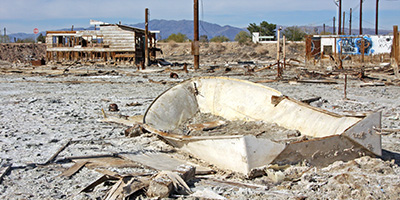
California’s largest lake, Salton Sea came into being when a desert sink was filled with diverted flood water from the Colorado River. Branded ‘the Californian Riviera’, this artificial body of water flourished as a major leisure destination in the 1950s and 1960s. When its largest community, Salton City, was developed in the 1950s as a resort community, a complex road system covering 52 square miles was laid out but never utilised. Rising and falling water levels and the increasing salinity of the lake have threatened communities along its shores since the year one. Today, parts of the settlements around the lake have either disappeared under water or are half-buried in mud. Much of the built infrastructure, including the Salton City’s marina and its beach club, has been gradually abandoned.

With property values declining, home sales plunging and a current population of only 944, Salton City has become a desert saga of capitalist failure. Those left behind, though, use the abandoned sites as refuges from the pressure to conform to normative lifestyles and celebrate their own marginality with gestures of defiance. For them, the forlorn landscape provides the backdrop for a life unrestrained by the demands of global capitalism. Their daily routines expose the tenacity and strength of everyday spatial practice via-a-vis the operations of the global market economy.

Retiring loners, who have settled down with their caravans in Bombay Beach, gather at the local village store, which proudly flies a black pirates flag. Across the sea, in Salton City, an unswerving school bus drives up and down the grid of deserted streets, new home-owners walk their dogs, sole travellers soak in the salty air and teenage kids take disused golf carts on a rampage. When darkness falls, the rebellious sounds of their go carts mark the settlers’ perseverance. Cruising the abandoned roads of Salton City, FOR SALE follows these sights and sounds. Vanishing in the desert mist, they echo glimpses of a near yet distant future.


5 - 7 June 2009
Institut für Kunstwissenschaft, Universität Bremen

Landschaft, Gehäuse, Orientierung

5 - 7 June
Institut für Kunstwissenschaft, Universität Bremen

Territoritalisierungs- und Naturalisierungsprozesse in Stadt, Wohnen, Körper

Landschaft ist historisch eine Repräsentationsfigur für Land, Natur oder Territorium. Als territoriale, soziale und ästhetische Konstruktion produziert sie – so die Hauptthese der Tagung - ein Ordnungsgefüge, das Repräsentationen der Erdoberfläche mit jenen von Bewohnerschaft in Beziehungen setzt und historisch eng mit der Herausbildung der industrialisierten Nationalstaaten und der bürgerlichen Gesellschaft verknüpft ist.

Ausgehend von diesem Konzept von Landschaft untersucht die Tagung historische und zeitgenössische Raum-, Aufenthalts- und Orientierungskonzepte zwischen Intervention und Dominanz in Repräsentationen und Praxen von Stadt, Wohnen und Körper der Moderne ab 1800. Fokussiert werden dabei Prozesse der Naturalisierung und Territorialisierung, durch die sich in bildliche wie räumliche Vorstellungen von Lebenswelt und Körper einschreiben.


12 April 2009
CONT3XT.NET - MEDIA/NET/ART

A PRACTICE WITHOUT DISCIPLINE | NETWORKED CULTURES

Franz Thalmair
from CONT3XT.NET in conversation with Peter Mörtenböck and Helge Mooshammer

In 2005 Peter Mörtenböck and Helge Mooshammer initiated the Networked Cultures project, a research platform on the potential of translocally networked spatial practices. Interviews, exhibitions, films and presentations are the many forms they collaborate on architecture, art and theory projects and investigate urban network processes, spaces of geocultural crises, and forms of cultural participation and self-determination. Networked Cultures investigates the cultural transformations in Europe through examining the potentials and effects of networked spatial practices.

The project interacts with art, architectural and urban practices across Europe and beyond to look at ways in which “contested spaces” allow for a multi-inhabitation of territories and narratives across cultural, social or geographic boundaries. Sites of alternative urban engagement are collected on a database which serves as a growing archive for research into emerging architectural cultures, including projects such as United We Stand - Europe has a mission, by Eva and Franco Mattes, the Trans European Picnic, organised by the New Media Center_kuda.org and V2_Institute of the Unstable Media, or projects like Cartography of the Straits of Gibraltar by the Spanish collective Hackitectura. In the following interview Peter Mörtenböck and Helge Mooshammer talk about the network as “the digital age’s ubiquitous object of desire”, the presentational form of socio-politically engaged creative projects and their own creative processes, defined as a “practice without discipline”.

[...more]


2 - 4 April 2009
AAH 2009 Conference, Manchester

Intersections

AAH Association of Art Historians
35th Annual Conference
Manchester Metropolitan University, Manchester


Saturday, 4 April 2009, 9:30 AM - 3:30 PM
Session: Networked Cultures: Politics of Connectivity

Against the background of global structural transformation, networks have become one of the most prominent concepts relating to the search for new forms of social cohesion and solidarity. The question as to what forms such connectivity should take is not only theoretical in nature but above all a question that points to the self-induced multiplicity of spaces that is continually generated by connectivities throughout the world. Networks both structure and constitute an operational field for these proliferating global entanglements of people, places and interests. They become incorporated in space in different ways: in the form of translocal zones of action, community support structures, expanded spheres of influence, spatial superimpositions and intensive contacts and contaminations.

The engagement with these developments on the part of art and architecture in recent years has resulted in a new form of praxis founded on collective production, process-guided work and transversal project platforms. Such a ‘disciplineless’ praxis of unsolicited intervention in spatial contexts renders legible the dysfunctional rules of planned spatial and cultural containment and creates an avenue for generating new forms of circulation amidst the political efforts to conceal this failure. It makes use of existing networks, expands and changes them, gives rise to new circuits and thereby sketches a mobile geography of self-determined utilisations of space and culture. Through practical and theoretical work involved in the parameters of networked art production, this session interrogates the meanings of this politico-aesthetic landscape together with the meanings of artistic, architectural and cultural engagement in these dynamics.


Chairs:
Peter Mörtenböck, Department of Visual Cultures, Goldsmiths College
Helge Mooshammer, Institute of Art and Design, Vienna University of Technology

Speakers:
Lee Rodney (University of Windsor), Road Signs on the Border: Transnational Insecurity since 9/11.
Duncan Cook (Royal College of Art), From Eco-politics to Eco-aesthetics: Hybrid Collectives and Creative Connectivities.
Urduja Manaoag (Geneva University of Art and Design), Philippine Resources on the Web: Filipino Diaspora and Internet Participative Platforms.
Ayse N. Erek (Yeditepe University), Remixing the Landscape: New Technologies and Place.
Sophie Hope (Birkbeck, University of London), What ever happened to cultural democracy?
Marga van Mechelen (University of Amsterdam), New Babylon or a virtual house for the artworld citizen.


25 - 28 February 2009
CAA 2009, Los Angeles

CAA 2009 Conference Los Angeles

CAA College Art Association
97th Annual Conference


Wednesday, February 25, 2:30 PM–5:00 PM
Concourse Meeting Room 408B, Level 2
Los Angeles Convention Center

Session: Stealth Public Art

Traditional, sanctioned models of public art generally do not ebb into extinction (although we sometimes may wish this were so) but coexist with new initiatives competing for legitimacy and currency. Object- and design-driven models of permanent public art persist, but other initiatives and innovations have produced an exciting, unsettling, and discursive range of artifactual, social, spatial, and political manifestations—including installations, interventions, performances, products, reenactments, and multiple forms of collaboration—that engage subjects and issues with agility and urgency. It is this thrilling instability and ubiquity that makes “stealth” public art difficult to dismiss and elusive to examine critically. The session comprises papers and presentations from artists, art historians, critics, and curators on alternative practices, projects, and initiatives that seek to question, bypass, or transform existing models and accepted conventions of public art. Whether peripatetic, unobtrusive, or clandestine, these frequently artist-initiated works anticipate imminent issues and stimulate critical ideas regarding the future of the public art and public space.

Chair: Patricia C. Phillips, Cornell University

Orange Work: Renegotiating Public Space, John Hawke, Suffolk Community College
Take It to the Air: Radio as Public Art, Sarah Kanouse, University of Iowa
Networked Cultures: Circulations of Unsoliticed Connectivity, Helge Mooshammer, Vienna University of Technology
Meanwhile, Zoe Sheehan Saldana, Baruch College, City University of New York


Thursday, February 26, 2:30 PM–5:00 PM
Ahmanson Auditorium, 1st Floor
MOCA, Grand Avenue

Session: Rights to Expression vs. Regimes of Power in the Public Sphere

This session encompasses papers addressing works of art, architecture, or other uses of visual culture that explore rights to self-expression in the public sphere. At the same time that new media have expanded our potential for expression, older forms (places of worship, public squares, monuments) still flourish. Concurrently, definitions of public and private space have been increasingly problematized and reconfigured through both globalization and the disembodiment of the traditional space-time continuum. Topics covered will include the public sculpture/installations of Thomas Hirschhorn, the politically volatile work of Argentine artist Leon Ferrari, and the impact of terrorist threats on altering future models for urban design.

Chairs: Noah Chasin, Bard College; Susan Merriam, Bard College

Means to Ends, Ends to Means: Repetition and Expression in the 1980s, Johanna Burton, Whitney Museum Independent Study Program
Marking Rights: The Politics of the Trace in the Work of Allora and Calzadilla, Yates McKee, Columbia University
Léon Ferrari versus the "Barbarism of the West", Todd Porterfield, University of Montreal
Structures of Experience: Thomas Hirschhorn against Architecture, Lisa Lee, Princeton University
Gunners and Runners: Counterterrorism Design in an Age of Fear, Peter Mörtenböck, Goldsmiths, University of London


14 January 2009
Public Art, Bauhaus University Weimar


Weimar Atrium, (access to shopping centre via underground car park)

Public Art
and New Artistic Strategies

Fakultät für Gestaltung
Bauhaus University Weimar

’Art, Architecture And Urban Space, In-Between Spaces’
lecture series in cooperation with ACC Gallery Weimar

Wednesday 14 January 2009, 6 pm

Peter Mörtenböck and Helge Mooshammer: Networked Cultures

Institute for European Urbanism at the Bauhaus University.
Albrecht-Dürer-Str. 2, room 107


_top


       contact