RESEARCH
DATA PUBLICS
-
Public plurality in an era
of data determinacy
OTHER MARKETS
--
Mapping typologies and conditions of informality:
How informal markets intersect with global governance
NETWORKED CULTURES
--
The struggle for new forms of artistic practice in an era of global deregulation
WORLD OF MATTER
--
An ecological view on resource politics
SEA OF MARBLE
--
Looking out to the sea: A navigational convergence on the imaginary and the realities of the sea
EXHIBITIONS
La Biennale di Venezia - 17th International Architecture Exhibition 2021
XX Architecture and Urbanism Biennial - Chile 2017
Ephemeral Urbanism
World of Matter
@ HMKV Dortmund
@ James Gallery New York
@ Ellen Gallery Montreal
@ Nash Gallery Minnesota
Networked Cultures -
documentary
Gunners & Runners
Trading Places
Networked Cultures
Gone City
Temporary Zones
Operation Desert
You'll Never Walk Alone
OPERATION DESERT
exhibited @
Borderline Cases, Art Gallery of Windsor, Canada, 2006
published in
MONU #08
March 2008, ISSN: 1860-3211
 |
BORDER URBANISM |
|
Operation Desert
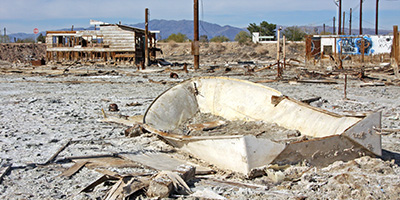
A trivial shortcut referring to the nature of the designated space of action, ‘Operation Desert’ is a codename readily used by US policies to label military interventions in the Middle East. Closer to home, at the Canadian-US borderland, however, it could be used to describe the urban wastelands left behind by cross-border capitalism and ruthless exploitation of land and human resources. A case in point along the border separating Canada and the United States are the post-industrial cities of Detroit and Windsor. In terms of urban and social prosperity they have both born the brunt of the restructuring of the automotive industry since the 1970s.
This has not just affected the physical richness of the urban space but also the social fabric of ethnic communities that had responded to the demand for workers and formed these spaces through their transnational migrant networks, as has been the case along Wyandotte Street in Windsor, the so-called Lebanese Street. This strip once formed the nucleus of a working class community arriving from the Middle East that has now suffered on the hands of US-capitalism, following the fate of many an American city. Today, Windsor’s city centre has been taken over by the contemporary American border economy of strip clubs, dingy bars and gambling halls. The Mosque and School of Ahlul-Bayt on Wyandotte Street borders upon ‘Adult by Choice’ and ‘Adult Entertainment’, the latter of which offered for rent already again. Their closed doors mark off an urban desert where it is impossible to distinguish between interior and exterior, exception and rule, and legality and illegality.
The border is a divided fiction that, dependent on the desired type of spatial and social organisation, gives rise to a particular material form. It is a place where the forces of production and migration meet in narrow channels, forming a marginalized territory of contested enclaves, buffer zones, military areas, protective strips and no man’s land: an intensified supply and negotiation space of geopolitical warfare.

Mosque & School of Ahlul-Bayt on Wyandotte Street, Windsor
14 March 2008 - New Issue:
MONU #08 - BORDER URBANISM
Magazine on Urbanism
(browse the entire issue #8 on YouTube)
MONU is distributed by Idea Books, Netherlands; Export Press, France; W.E. Saarbach GmbH, Germany; and Disticor Magazine Distribution Services, Canada.
MONU is available at selected newsstands and bookshops worldwide. Among others:
Flammarion Centre, Cedex 04, 75163 Paris, France
NAI Booksellers, Mauritsweg 23, 3012 JR Rotterdam, Netherlands
Art Data, 50 Cunnington Street, London W4 5HB, United Kingdom
Pro Qm, Alte Schönhauser Str.48, 10119 Berlin, Germany
Architext Melbourne, 41 Exhibition Street, Melbourne VIC 3000, Australia
St. Marks Bookshop, 31 Third Avenue, New York, NY 100003, USA
see also
MONU #05 - BRUTAL URBANISM
'Happy Slapping – Urban Violence in the Age of Camera Phones', Monu #05 - Magazine on Urbanism (Brutal Urbanism - Violence and Upheaval in the City), 2006
pdf.file - online
_back to home
BOOKS
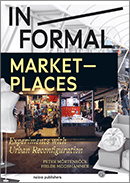
IN/FORMAL
MARKETPLACES
PLATFORM
URBANISM
AND ITS
DISCONTENTS
DATA
PUBLICS
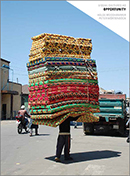
VISUAL
CULTURES
AS
OPPORTUNITY
INFORMAL
MARKET
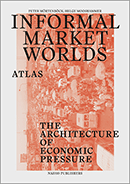
WORLDSAtlas
INFORMAL
MARKET
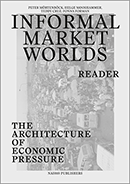
WORLDSReader
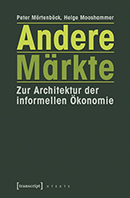
ANDERE
MÄRKTE
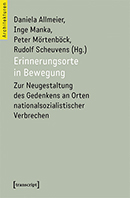
Erinnerungs-
orte
in
Bewegung
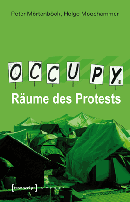
OCCUPY:
Räume des Protests
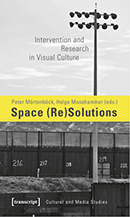
Space (Re)Solutions:
Intervention and Research in Visual Culture
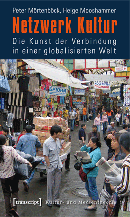
Netzwerk Kultur:
Die Kunst der Verbindung in einer globalisierten Welt
Zwischen Architektur und Psychoanalyse
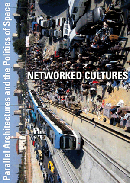
Networked Cultures:
Parallel Architectures and the Politics of Space
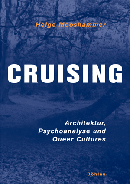
Cruising:
Architektur, Psychoanalyse und Queer Cultures
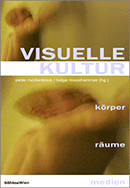
Visuelle Kultur:
körper, räume, medien
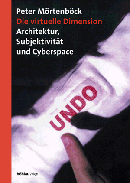
Die virtuelle Dimension:
Architektur, Subjektivität und Cyberspace